Tamron 70-200mm F/28 Sp Di Usd for Sony a-mount Review
Tamron seventy-200mm f/2.viii SP Di VC USD Lens Review

While the Tamron 70-200mm f/2.8 Di VC USD Lens is non Tamron'southward showtime 70-200mm f/2.8 lens, it is their start version to include vibration control. VC lone is a smashing upgrade characteristic, only the upgraded image quality in this lens is also large bonus. This lens 70-200 VC overall dandy image quality and practiced functioning at a moderate cost.
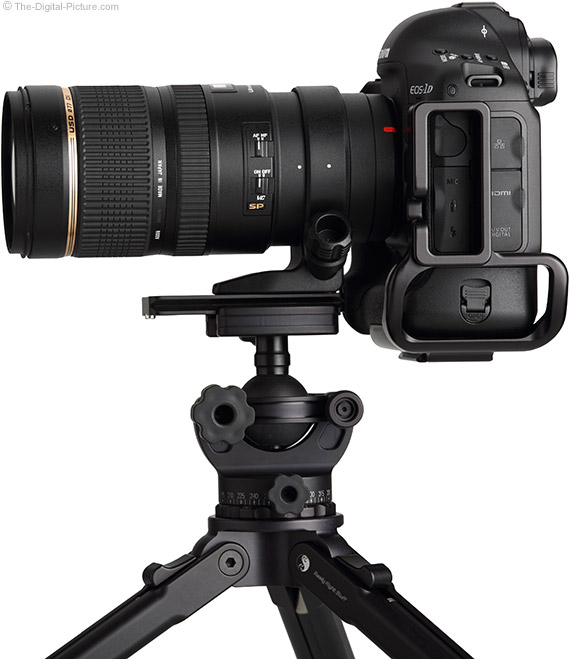
There are few of us that can't make great use of a stabilized 70-200mm f/2.viii lens. The seventy-200mm focal length is what I often recommend for a photographer's second lens. This focal length range falls nicely above most general purpose zoom lenses and works well for more-distant subjects or for more-compressed perspectives.
Here are a pair of 70-200mm focal length range examples.

The New York City skyline comparison was photographed from Liberty Park in Weehawken, NJ.
APS-C/1.6x FOVCF sensor format DSLR owners will become an angle of view similar to a full frame 112-320mm lens.
Have kids? Or grandkids? This is a great lens to hunt them around with. I normally recommend such a lens for portraits, for weddings, parties, concerts and other indoor events, for indoor and outdoor sports, for landscapes and for large and/or close wild animals.
Critical for many uses, and especially critical for an indoor consequence lens, is stabilization. This lens has it, Tamron calls information technology vibration control (VC) and it works very well. The Tamron seventy-200 VC'southward iv-stop image vibration control keeps the viewfinder stable on startup and shutdown and keeps its presence down by beingness very quiet. You will hear some light fluttering in the lens until the stabilizer fully starts, but it is and so very quiet.
Throughout this review, I will be comparing the Tamron seventy-200 VC to the Sigma 70-200mm f/2.8 EX DG OS HSM Lens and the Canon EF seventy-200mm f/2.8 50 IS Ii USM Lens. In regards to stabilization sound, the Sigma Bone (Optical Stabilization) and Canon IS (Image Stabilization) lenses are both louder – both make an easily audible click when starting and stopping. The Canon provides a less-jittery image than either the Tamron or Sigma when adjusting the framing while stabilization is active.
My success with the Tamron's VC very closely matches my success with the Canon's IS and modestly bests my success with Sigma'southward Bone. At 70mm, I am getting a very good keeper rate at ane/8 seconds with a still-good sharpness rate downwards to .three seconds. At 200mm, 1/15 2nd exposures are generally quite successful.
These results represent nearly iv-stops of assist from VC for me. With each stop representing a 2x divergence in the amount of low-cal needed to handhold a shot, 4 stops of assist is pregnant. Equally long equally the subject is non moving.

From an paradigm quality perspective, the Tamron lxx-200mm f/2.eight Di VC USD Lens impresses. From 70mm through 135mm, with a wide open f/2.8 aperture, images are quite sharp from the centre to the outer full frame image circumvolve. At 200mm, a modest driblet in sharpness can exist noticed.
Narrowing the aperture 1 finish from wide open usually improves the image quality delivered by a lens. And in this case, the improvement is modest over almost of the focal length range - and modest is all that is needed to be fully impressive save at 200mm. At 200mm, the improvement at f/iv is more than noticeable (and more needed). 200mm f/4 corners are yet showing slight softness that is better-resolved with an f/5.six aperture setting.
The Tamron seventy-200 VC has noticeably better image quality than the Sigma lxx-200 Os at f/2.viii. The differences are less noticeable at f/4, only the Tamron remains the image quality leader except at 200mm where the Sigma performs better in the corners.
You purchase a 70-200 f/2.8 to utilise at f/ii.eight. Otherwise, buy a Canon EF 70-200mm f/iv 50 IS USM Lens. It will give yous modestly better image quality in a smaller and lighter package – with a lower toll tag. Thus, I feel that for most, the Tamron VC is a meliorate selection than the Sigma Os from an image sharpness perspective.
The Canon seventy-200 L IS II is perhaps the best zoom lens I've ever used – and represents a very formidable competitor to any lens in this class. Surprising is that, at its lower price signal, the Tamron 70-200 VC delivers prototype quality very close to the Canon IS II until the long end of the focal length range where the Canon easily bests the Tamron. Before deciding that yous are going to give up that Canon advantage for the lower price, call back that we tend to almost-utilize the total extents of the focal length range in our zoom lenses. And 200mm is perhaps the most important focal length in a seventy-200mm f/2.8 stabilized lens. The better 200mm prototype quality is likewise translated into better with-extender image quality at the 200mm focal length setting.
The 70-200 VC has noticeably improve f/two.8 prototype quality than its predecessor, the Tamron 70-200mm f/ii.viii Di Macro Lens. This comparing at f/two.viii shows perhaps the most-improved focal length. Stopped down aperture comparisons between these ii lenses bear witness more than similarity.
As is common, at a 2-stop narrower than wide open aperture (f/5.half dozen), image sharpness is no longer a meaning differentiator between all of these lenses. The Canon all the same delivers slightly better image quality, just the playing field is far more level.
Adding to the 70-200 VC'southward soft corner wait at the longer focal lengths is a small-scale amount of CA (Chromatic Aberration) showing there. The various wavelengths of light are non being focused identically in the mid and peripheral portions of the epitome circumvolve. Bated from a slight amount of CA at 70mm, this lens is essentially CA-gratis otherwise.
Look seventy-200 VC full frame f/two.8 corner shading to be virtually 2 stops at 70mm, ane.v stops at 100mm, 2 stops at 135mm and 2.5 stops at 200mm. Every bit always stopping down reducing the vignetting. F/iv reduces vignetting by .five - 1 stop and f/5.6 affects a more modest reduction. A minor .5 stops remains visible in 200mm f/8 corners.
How does the 2-finish difference in 200mm f/two.8 vs. f/viii vignetting compare in a real world full frame image? Observe below.

My archer model obviously was not stationary between my shots (or her shots?), but the sky did not motion. The corner shading tin be used to draw the viewer's eye to your subject field. Or more depth of field with less peripheral light fall-off can be achieved by using a narrower aperture such as f/8 (notice that the bow remains in focus).
APS-C format DSLR owners seldom have much to worry about regarding vignetting from total frame compatible lenses. And this is once more the instance with the 70-200mm VC. Expect a just-noticeable i cease of vignetting at 200mm f/ii.eight.
The Tamron seventy-200 VC's vignetting pattern is very similar to the Sigma 70-200 Bone'south with the Sigma having slightly more vignetting at 200mm f/ii.viii. The Canon 70-200 IS II has less vignetting – equally much every bit .5 stops less at f/2.viii. The stopped downwardly differences are, equally expected, less.
With 23 lenses in 17 groups, it is not surprising that the 70-200 VC shows a noticeable amount of flaring with a bright light in the frame - like the competitors. The Sigma, with 18 lenses in 15 groups, shows simply slightly less flare and the Canon with 23 lenses in nineteen groups shows very slightly more. The differences are not enough to exist differentiators from my perspective.
Zoom lenses, as a potent rule, prove barrel baloney at the wide cease and pincushion distortion at the long finish of their focal length range. The big unknowns are generally: How potent is the distortion? And where is the virtually-0 baloney crossover signal? The Tamron seventy-200mm VC lens brings no surprises with a minor corporeality of barrel distortion at 70mm, a crossover point in the 85mm neighborhood and a modest amount of pincushion by 200mm. The Sigma and Canon lenses are not considerably different in regards to distortion.
Likewise non much unlike is the quality of the background blur (bokeh) these lenses produce. The Catechism uses an 8-bract rounded blueprint while the Tamron and Sigma apply 9-blade rounded designs.
Hither is a 200mm bokeh comparison created using a stationary camera position with the lenses focused at the same distance. Obvious is that the Canon is producing larger blur details – even with a 1-stop narrower aperture (the f/11 example). The Canon has a longer true focal length than the Sigma and Tamron lenses – peculiarly at short focus distances. I'll talk more than most this after in the review, simply the Tamron also has modestly less focal length than the Sigma in this case.
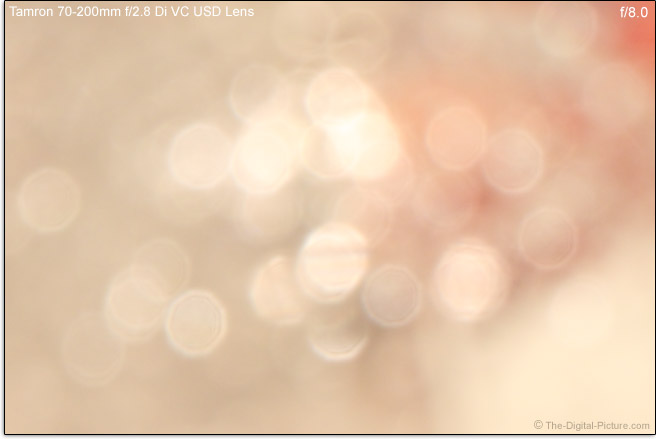
Bated from the divergence in the magnification of the blurred subjects, I don't run across whatever differentiating qualities in the results of this comparison. All three lenses are looking skillful.
Overall, the Tamron 70-200mm f/2.8 Di VC USD Lens is quite impressive from an image quality perspective. I would similar to run into better sharpness from the of import 200mm f/ii.8 setting, but this lens otherwise performs very well. The more expensive Canon remains the better choice, but the Tamron's image quality would be my like shooting fish in a barrel choice over the Sigma. Compare these lenses using the epitome quality comparison tool linked to at the top of the each review. You will meet the differences.

As indicated by the "USD" acronym in its name, the seventy-200mm f/2.8 VC Lens uses Tamron'south relatively new and very squeamish Ultrasonic Drive for autofocusing. This implementation of USD is quiet (yous tin can hear a "shhhh" sound if you listen advisedly) and fast. Fast enough that it is hard to discern a deviation between it and the Canon EF 70-200mm f/2.8 L IS Ii Lens in side-by-side comparison over full near-minimum to near-infinity focus distance adjustments. And the Tamron is noticeably faster than the Sigma seventy-200 OS in this comparing. With more normal focus distance adjustments, the Canon focuses very noticeably faster and the Sigma becomes more than comparable to the Tamron. Hurting the Tamron are the fine-tuning adjustments made later on the initial nigh-in-focus country is achieved.
Focusing is internal (filter threads exercise not rotate with focusing) and FTM (Total Time Manual) focusing is supported. I usually much adopt having FTM, just the rear-positioned focus ring makes this feature a bit of a liability. With my left paw resting on this ring, it is possible to inadvertently change the focus distance setting while composing the final image framing.
No focus distance limiter switch is provided.
One shot AF has proven accurate, though my copy of the Tamron 70-200mm f/2.8 Di VC USD Lens has a slight, but consistent backfocusing result on both of my Catechism 5D Marking 3 cameras. Consistent backfocusing can be corrected by AFMA - or past the manufacturer. It is the inconsistent focus accuracy issues that render a lens far less useful.
I gave the seventy-200 VC'southward AF system a few practiced AI Servo workouts. And it performs reasonably well a bulk of the time.

Troubling is that this lens, at random, will completely neglect these tests. I can be shooting a 12 fps Canon 1D X bursts with each frame being in-focus until, for no apparent reason, every frame becomes strongly out of focus. The lens normally fails to recover from this land until a new burst is started. It is like the lens AF system loses its drive train.
I have strings of xx+ completely blurred shots. The out of focus images tin can start on the showtime shot of a sequence or can show up deep into a burst – when the field of study is typically closer and faster-endmost the relative distance to the camera. When this bibelot happens, no AF point shows in Canon DPP's Quick View. Bated from this occasional issue, I am satisfied with AI Servo performance.
Note that the Tamron 24-seventy VC and 70-200 VC reportedly have the same ID from a Nikon DSLR standpoint. This means that any autofocus aligning washed in-camera will affect both lenses similarly. If this is your situation, send the lenses in need of calibration to Tamron.
Videographers should note that 70-200 VC subjects modify size a noticeable corporeality during focus pulling at 200mm, simply subjects practice not modify size about every bit much at 70mm. This lens performs better than the Canon IS Ii, but not equally well as the Sigma Os, in this regard.
This lens is not parfocal. Zooming from 200mm to 70mm will shift focus to a longer distance. This inverse as well remains truthful – zooming from 70mm to 200mm will shift focus to a shorter distance. Equally with most zoom lenses, refocus afterward irresolute the focal length.
| Model | MFD | MM | |
| Canon EF 70-200mm f/ii.8 L IS Ii USM Lens | 47.2" | (1200mm) | 0.21x |
| Sigma lxx-200mm f/2.8 EX DG OS HSM Lens | 55.one" | (1400mm) | 0.13x |
| Tamron 70-200mm f/2.8 Di VC USD Lens | 51.two" | (1300mm) | 0.13x |
| Tamron lxx-200mm f/2.8 Di Macro Lens | 37.4" | (950mm) | 0.32x |
| Canon EF 70-200mm f/4 Fifty IS USM Lens | 47.two" | (1200mm) | 0.21x |
There are some interesting numbers in the chart above. The Canon f/2.8 IS 2 has a significantly higher maximum magnification (MM) spec than the other f/2.8 image stabilized lenses. But, the minimum focus distance (MFD) of these lenses do non appear that significantly smashing. And actual MFD testing using transmission focus places these lenses even closer than the chart in a higher place indicates (use the measurements and specs link at the top of the review to see these results). But, the Canon lens indeed produces a very noticeably larger magnification at MFD.
The Sigma gives upwards significantly more of its focal length at MFD than the Canon does. And the Tamron gives up even more. So, one of the Tamron and Sigma shared 0.13x MM values does not appear right. The Tamron withal does non quite match the Canon for max focal length even at longer focus distances. The Sigma as well trails the Catechism somewhat at altitude.
This point was driven home for me when I used the Tamron to shoot the production images for the Sigma 35mm f/1.4 Lens Review. I could not get the tighter shots I typically go with the Catechism 70-200 f/4 IS that I usually use for these photos.
The lxx-200 VC is certainly not a macro lens, just unlike its predecessor (and unlike the Sigma 70-200 Os'south predecessor), information technology does not claim to exist.
This lens will work with extension tubes, but extender compatibility is the feature that can make the biggest magnification departure. This lens is compatible with the Tamron one.4x and 2.0x SP AF Pro Teleconverters.
You add together a teleconverter (extender) because y'all desire a longer focal length than is natively found in the lens – because you are focal length limited. And this means that yous are primarily interested in the prototype quality of the lens and TC combination at the lens' longest native focal length – 200mm in this case. This is the focal length we lab test the extender combinations at. Unfortunately for the otherwise stellar-performing 70-200 VC, it's longest focal length is its weak point.
Calculation a Tamron 1.4x TC to the lxx-200 VC creates a 98-280mm f/four VC lens. Image sharpness takes a noticeable striking at 280mm with a wide open f/iv aperture. Very good sharpness returns at f/five.vi except in the full frame corners that remain soft. The corners are improved at f/eight and farther improved at f/xi. The Tamron 1.4x TC adds barrel distortion that helps equalize the 70-200 VC'due south native pincushion distortion.
Adding a Tamron 2.0x TC to the seventy-200 VC creates a 140-400mm f/5.six VC lens that retains autofocus capabilities on most Canon EOS DSLR cameras. Images at 400mm with a wide open up f/v.half dozen aperture are downright blurry. Just pretend this lens combo has an f/8 max aperture for practical utilize. And the image quality at f/8 is only marginal with very poor corner performance. Corners are not skilful even at f/xi. Similar the 1.4x, the Tamron 2.0x TC adds barrel distortion that helps equalize the lxx-200 VC's native pincushion baloney.
Apply the "Image Quality" tool link at the peak of this review to see these test results for yourself.
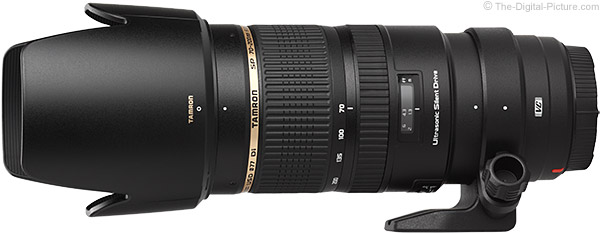
If you have used Tamron lenses recently, the Tamron lxx-200mm f/2.eight Di VC USD Lens will await and feel familiar to y'all. A slightly shiny plastic lens barrel with wide-spaced, deeply ribbed rubber rings and a gold proper name plate ring. While I prefer the Canon and Sigma from a look and feel perspective, your personal preference may vary.
The Tamron's zoom and focus rings are smoothen (very slightly scratchy) with no play. Notation that these rings rotate in the Nikon-standard management - opposite that of Canon'southward lenses (and the Sigma 70-200mm f/two.8 OS Lens). Information technology takes some adjustment if you are used to one rotation management and using a lens that rotates in the opposite management.
Aiding lens barrel smoothness is the Tamron'due south flush switch panel. The Canon 70-200 f/2.viii L IS II has twice as many switches in a slightly raised panel, but the switches are nearly affluent with the lens barrel but across them. The Canon's 2 additional switches command focus altitude limit settings and provide IS Mode I and 2 setting options. The Sigma has a very noticeably raised switch panel.
I already mentioned that I do not like the Tamron's rear-positioned focus ring. In employ, my left paw's fingers residue on this ring. Especially with the ease that this lens' focus ring rotates, there is a real risk that the focus altitude setting gets changed later autofocus lock – past my grip on the lens changing slightly I strongly prefer the Catechism design with the zoom ring in the rear. I also like to be able to modify focal length without moving my grip hand forward, and I much prefer the lens balance when actively using the rear-positioned zoom band.
This lens has a nicely-sized zoom ring and a relatively narrow-but-quite-usable focus ring. The Canon focus band has virtually twice equally much surface area. The Sigma focus ring is well-nigh the aforementioned size as the Tamron's, merely it has about half every bit much rubber grip surface.
The Tamron lxx-200mm f/2.eight Di VC USD Lens has less focus ring rotation than either the Canon or the Sigma (60° vs. 62° and 72°), just the difference volition be immaterial to well-nigh of u.s.a.. The VC also has slightly more zoom ring rotation (143° vs. 137° and 120°). Again, this difference volition be immaterial to most.
I dear the fixed-size design trait these seventy-200 f/2.eight lenses share. At that place is no barrel extension when zooming to a longer focal length.
While Sigma, Canon and Tamron are using quality plastics in their construction, seventy-200mm f/2.8 lens design requirements dictate that the weight – and size – of such a lens be noticeable. The weight and size differences between the 3 lenses I've been comparing are insignificant.
| Model | Weight | Dimensions w/o Hood | Filter | Year | ||
| Canon EF 70-200mm f/ii.8 L IS 2 USM Lens | 52.6 oz | (1490g) | 3.5 x 7.8" | (88.eight ten 199mm) | 77mm | 2010 |
| Sigma 70-200mm f/2.eight EX DG Bone HSM Lens | l.5 oz | (1430g) | three.4 ten vii.8" | (86.iv 10 197.6mm) | 77mm | 2011 |
| Tamron 70-200mm f/ii.8 Di VC USD Lens | 51.9 oz | (1470g) | three.four 10 seven.4" | (85.8 10 188.3mm) | 77mm | 2012 |
| Tamron seventy-200mm f/two.8 Di Macro Lens | 46.half dozen oz | (1320g) | 3.5 x vii.six" | (90 x 194mm) | 77mm | 2008 |
| Canon EF seventy-200mm f/two.8 Fifty USM Lens | 46.2 oz | (1310g) | three.iii x 7.6" | (85 x 194mm) | 77mm | 1995 |
| Catechism EF 70-200mm f/4 Fifty IS USM Lens | 26.8 oz | (760g) | 3 x six.8" | (76 x 172mm) | 67mm | 2006 |
| Canon EF 70-200mm f/4 L USM Lens | 24.ix oz | (705g) | 3 10 6.viii" | (76 10 172mm) | 67mm | 1999 |
For many more comparisons, review the consummate Tamron 70-200mm f/2.8 Di VC USD Lens Specifications using the site's Lens Spec tool.
You lot are going to know when you have this lens mounted – and you are going to feel the weight in your artillery and shoulders if you lot utilize the lens for hours on stop. But this is not a hard lens to use for most of united states.
This lens mounted to a DSLR may not fit in your standard zoom lens case. The Lowepro Toploader Pro 75 AW is a example I oftentimes recommend for this carry solution.
Hither are the three stabilized 70-200 f/2.eight lenses side-by-side.
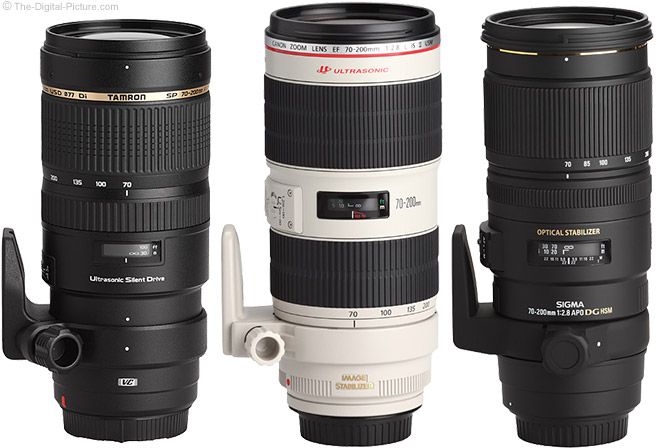
Positioned in a higher place from left to right in their fully retracted positions are the following lenses:
Tamron lxx-200mm f/2.eight Di VC USD Lens
Canon EF 70-200mm f/ii.8 Fifty IS Two USM Lens
Sigma seventy-200mm f/two.8 EX DG Os HSM Lens
The aforementioned lenses are shown beneath in their fully extended states (the aforementioned size in this case) with their lens hoods in place.

We are looking at telephoto lenses here, and with these lens types come a large lens hood (included in the box with each of these 3 lenses). Large lens hoods take up more room, only they also provide great protection to the front lens chemical element. Protection from impact, protection from pelting and water spray, and of grade, protection from the lord's day and other bright lite source.
While the Tamron and Canon lens hoods are like in overall length and shape, the Tamron is shallower on the sides. Canon utilizes a flocked interior to blot all light hitting inside the hood while the Tamron and Sigma use a plastic interior with ridges designed to foreclose reflections into the lens. The Canon design is more effective, simply ... few will find the differences to be significant. The Sigma lens hood is longer with less-rounded corners. All three have ends flat enough to allow the lens to sit down upright when balanced on them, just ... apply this technique with caution.
The center-pinch lens cap is easily installed or removed even with this large lens hood in place.

Equally a rule, seventy-200 f/two.8 lenses come up with a tripod band (these rings are typically optional for the lxx-200 f/4 lenses). The Sigma and Tamron tripod rings utilize a hinged design to let easy removal while a photographic camera is mounted. The Canon tripod ring does non count on a hinge pin for strength.
Accidentally removing the Canon ring is most impossible. Accidentally removing the Tamron ring is possible, just not likely equally the spiral requires about 8 full rotations to fully open. On the other paw, the Sigma quick release friction screw requires less than ninety degrees of rotation to go from really tight to completely loose. At completely loose, only a minor tug outward on the release spiral is required to release Sigma lens from the ring. This ease of release makes me a bit nervous.
The Tamron tripod ring is virtually every bit polish-operation equally the Canon, lacks the Canon's internal release mechanism'southward bumps and with plenty of friction adjustment available, desired resistance level can be dialed in. The release hinge has a sharp edge that volition strength you to suit it and so your that manus does non come up against it. The Canon ring allows more than clearance for fingers wrapped effectually the lens, just the Tamron and Sigma rings are lower profile.
All of these lxx-200mm lenses utilise the same 77mm filter size. While they are not small, 77mm filters are one of the most common filter sizes. You will probably want to have filters for each of your lenses, but having a common filter size permits filter sharing.
You are on your ain for a Tamron 70-200mm lens case every bit none is included in the box.
Like the Canon 70-200mm f/two.8 Fifty IS 2, the Tamron 70-200mm f/two.viii Di VC USD Lens is a conditions-sealed lens. Those comparing the Tamron to the Sigma 70-200mm Bone should note that the Sigma is not sealed.

My Tamron seventy-200 VC was purchased retail.
The Tamron 70-200mm f/two.8 Di VC USD Lens, at review time, is available in Canon (reviewed), Nikon and Sony/Minolta mounts. My standard disclaimer: There are potential issues with 3rd party lenses. Since Tamron reverse engineers (vs. licenses) manufacturer AF algorithms, there is always the possibility that a DSLR body might not back up a (likely older) 3rd political party lens. Sometimes a lens tin be made uniform past the manufacturer, sometimes not. In that location is also the gamble of a problem that results in the lens and body manufacturers directing blame at each other. Canon'due south 1 year warranty does non compare to Tamron USA'southward 6-year warranty.

Why purchase a third party/non-photographic camera-manufacturer-make lens for your camera? The 3rd party lens may have improve quality – with meliorate image quality beingness an especially attractive reward. The third political party lens may have an of import feature that the photographic camera brand does not offer – a unique focal length range for case. Or, the third party lens may exist less expensive.
That last reason is the most common reason people buy 3rd party lenses. And it is the master reason to buy the lxx-200 VC over the Canon equivalent lens. If you lot tin can afford it, the Canon EF 70-200mm f/ii.8 50 IS Two USM Lens remains my potent recommendation for a lens in this grade.
If you budget is not potent plenty for the Canon, I highly recommend the Tamron lxx-200mm f/2.8 Di VC USD Lens. While it is non an inexpensive lens itself, the 70-200 VC delivers image quality worthy of its cost. This lens is going to deliver some great images.
Bringing you this site is my full-time job (typically lx-80 hours per calendar week). Thus, I depend solely on the commissions received from you using the links on this site to make whatsoever purchase. I am grateful for your support! - Bryan
My Recommended Tamron lxx-200mm f/2.viii Di VC USD Lens Retailers
Rent the Tamron 70-200mm f/2.eight Di VC USD Lens
The Tip Jar
More Tamron 70-200mm f/two.viii Di VC USD Lens Related Information
Bryan Recommends Buying Information technology Hither
Source: https://www.the-digital-picture.com/Reviews/Tamron-70-200mm-f-2.8-Di-VC-USD-Lens-Review.aspx

ارسال یک نظر for "Tamron 70-200mm F/28 Sp Di Usd for Sony a-mount Review"